
Control Loop
This motion controller is a targeting controller; the onboard microprocessor updates the Target Position and Target Speed values each control loop (1ms or 2ms, depending on the number of modules). For point-to-point moves, Target Positions are generated so the target speed follows a profile. The Mode, Acceleration, Deceleration, Speed, and Command Value (requested position) are used to generate the profile. They are specified by the user, and can be changed while the axis is moving. A trapezoidal profile is shown here.
The Actual Position, measured by any of the RMC’s position transducers, is compared with the Target Position to determine the position error. Every control loop the position error is used to calculate the closed loop components of the drive output. It is multiplied by the Proportional Gain to calculate the proportional component of the drive output. The accumulated position error is used, along with the Integral Gain, to calculate the integral portion of the drive output. The change in position error, along with the Differential Gain, is used to calculate the differential portion of the drive output.
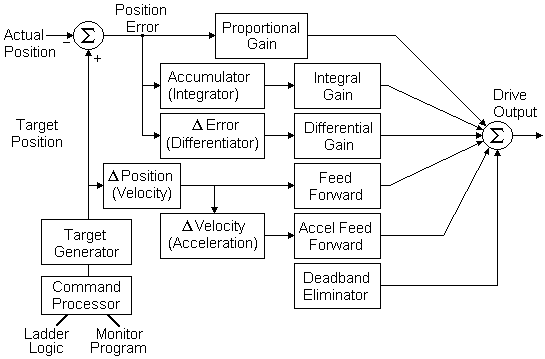
In addition to the closed loop drive, this motion controller has two feed forward terms, made up of Extend and Retract Feed Forward, and Extend and Retract Acceleration Feed Forward. These feed forward terms give approximately the drive needed to make the axis follow the target, freeing the PID loop to correct for non-linearity in the system and changes in system load.
Drive Output
The drive generated by the motion controller is sent through optical isolation to a 12-bit digital-to-analog converter (DAC). The output from the DAC is amplified to provide a ±10 volt output to the hydraulic valve. Servo valves that need current input require a voltage-to-current converter (Delta part number VC2100). Other proportional valves are typically driven using another type of external amplifier.
Copyright (c) 1997-2015 by Delta Computer Systems, Inc.