September 2025
NEWSLETTER
|
|
IN THIS ISSUE
- In the News
-
When it's All Riding on Polyurethane Tube
- Design World
-
Case Study: Vaagen Brothers Lumber, Inc. Upgrades Motion Control for Improved Lumber Stacking
- International Forest Industries
-
Underdamped Hydraulic Systems - Valve to Cylinder: Long Hose vs Short Pipe
- YouTube
-
Parallel Interfering Gears (PIG) Demo
- YouTube
- Tech Tip
-
Upcoming Events
|
|
|
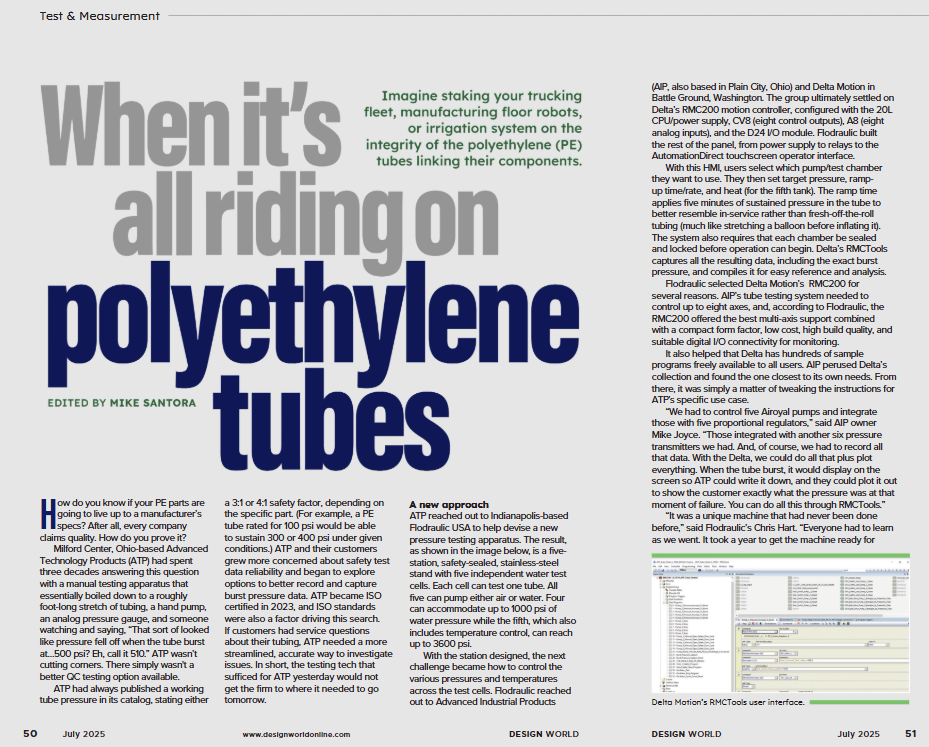
When it's All Riding on Polyurethane Tube
When safety and quality are on the line, guesswork is not enough. Advanced Technology Products (ATP) needed a better way to prove the reliability of their polyethylene tubing, so they partnered with Flodraulic, AIP, and Delta Motion to build a groundbreaking burst testing system powered by the RMC200. With advanced control, data capture, and flawless performance from day one, ATP can now back up its quality claims with hard data and deliver greater confidence to customers.
|
|
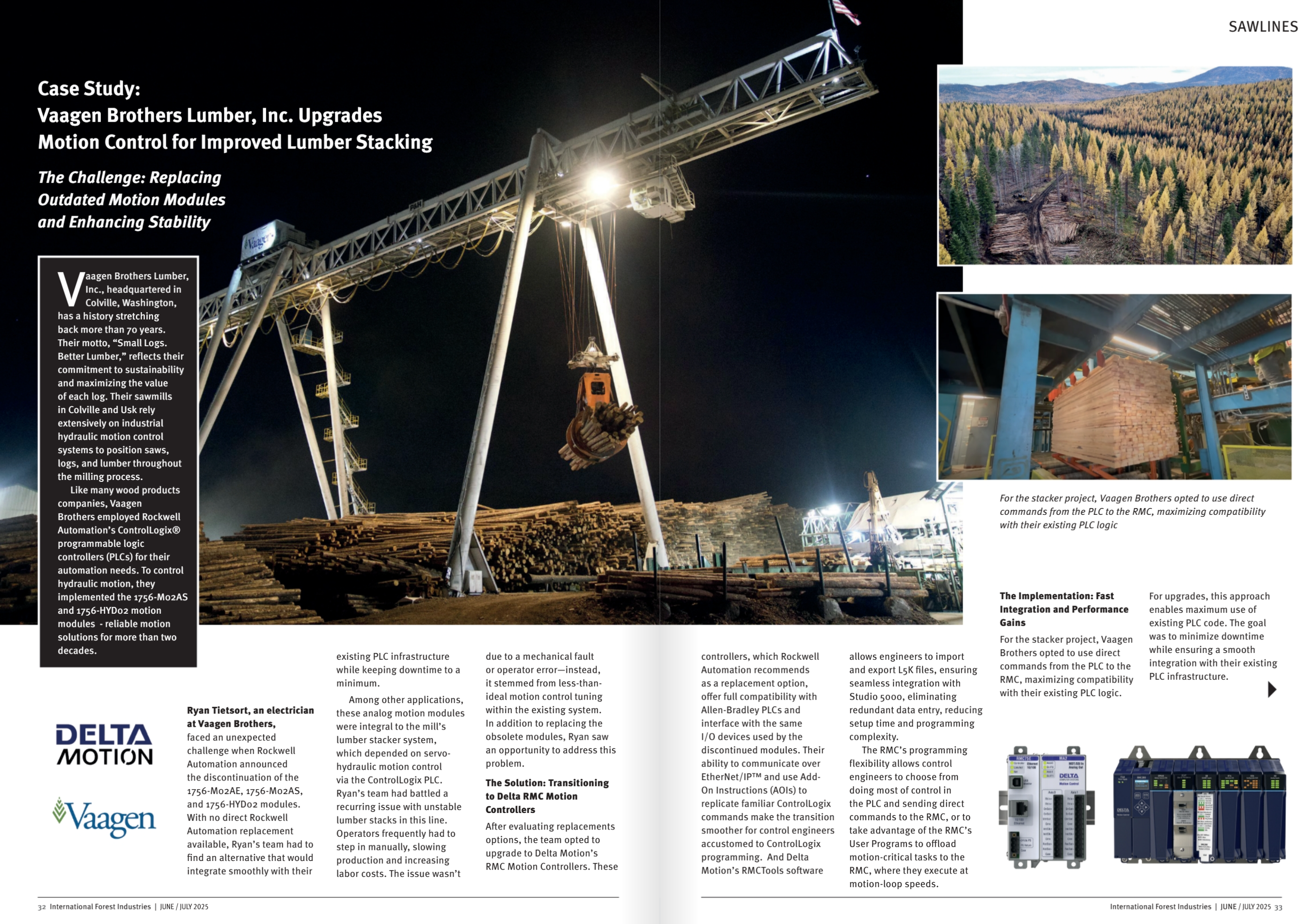
Case Study: Vaagen Brothers Lumber, Inc. Upgrades Motion Control for Improved Lumber Stacking
When Rockwell’s motion modules were discontinued, Vaagen Brothers Lumber faced the challenge of keeping its sawmill operations efficient and stable. Discover how they turned this obstacle into an opportunity by upgrading to Delta’s RMC Motion Controllers. The result was tighter control, reduced downtime, and improved lumber stacking consistency.
|
|
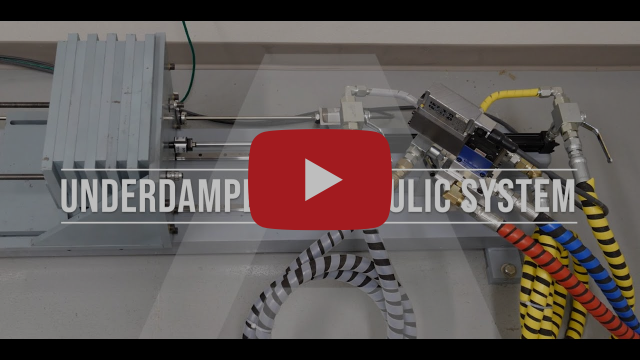
Underdamped Hydraulic Systems - Valve to Cylinder: Long Hose vs Short Pipe
In this video, you will see how the connection between a hydraulic cylinder and valve affects performance, and why some setups are much harder to control.
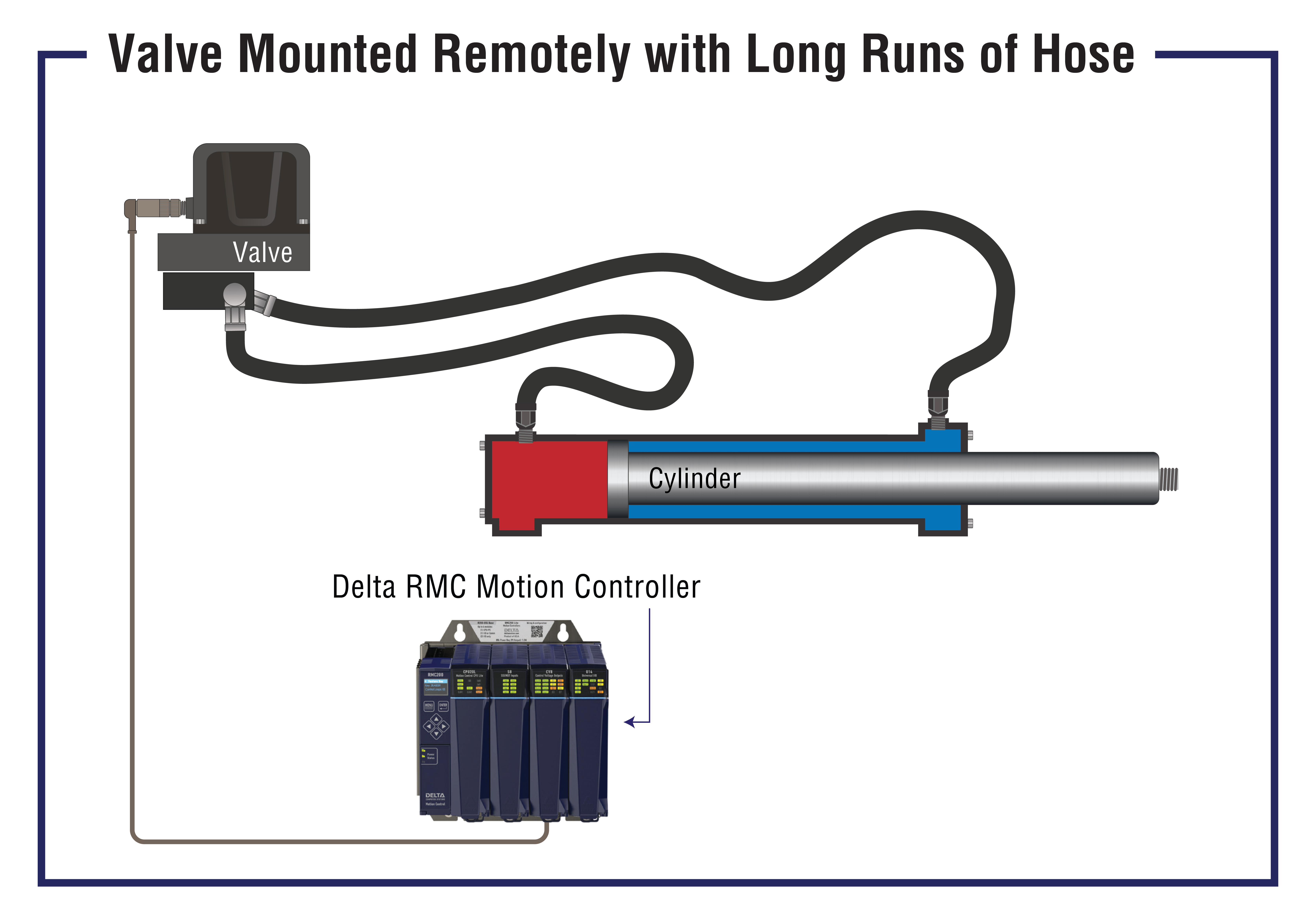
When long runs of hose are used, the added fluid volume and hose flexibility create a springy system. Oil compresses, hoses expand, and the circuit behaves like an underdamped spring–mass system.
Switching to hard pipe makes the system stiff with minimal compliance. Even with basic PID gains, the system starts, stops, and holds position without oscillation. Simply put, hard pipe allows for much tighter control.
For optimal control, mounting the valve directly on the cylinder is best. If remote mounting is necessary, use hard pipe and keep hose length to a minimum. For systems where it is impractical to reduce hose length to where it is insignificant, Delta’s RMCTools provides second-order tuning options that can control even the most challenging applications.
|
|
|
To learn more, visit our forum at forum.deltamotion.com, watch the full webinar on YouTube, or explore more resources at deltamotion.com/support/webinars, call us at +1-360-254-8688, or email support@deltamotion.com.
|
|
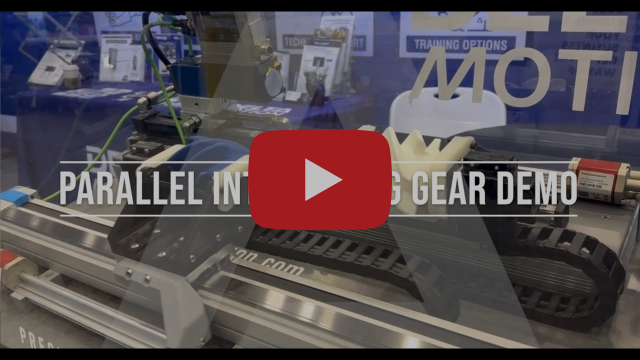
Parallel Interfering Gears (PIG) Demo
In this video, you will see four synchronized axes in action: two rotary electric motors, a linear hydraulic cylinder, and a linear electric toothed belt axis, all operating under precision position control.
Synchronizing servo-hydraulic and servo-electric motion has never been easier. With Delta Motion’s RMC200 EtherCAT MainDevice, you can achieve the highest performance from your EtherCAT-enabled devices as well as directly connected sensors and actuators. From a single motion controller, synchronize up to 50 axes of electric and hydraulic motion. Control position, velocity, torque, pressure, or force with repeatable, precision accuracy. Reduce frustration and boost productivity with Delta’s RMC motion controllers.
|
|
Using Orifices to Improve Hydraulic Motion Control
In most closed-loop motion applications, a fixed orifice is generally not desirable in the circuit. However, our tech support team has seen several different instances where an orifice can make all the difference.
|
|
|
1. Force control
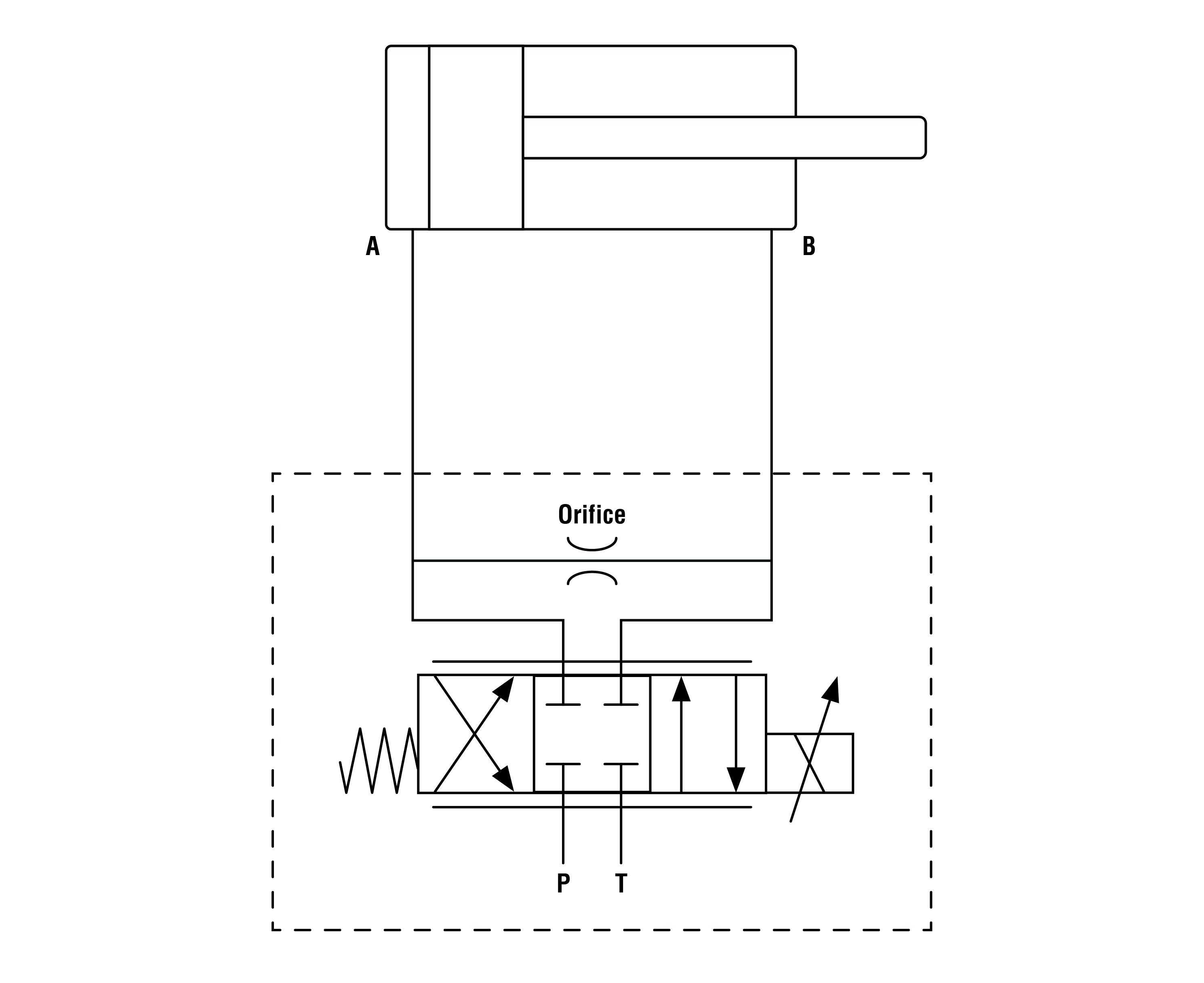
In precise pressure/force control applications, hydraulic proportional valves can be required to meter small amounts of oil right around the zero point. Sometimes, systems controlling the force of a cylinder with a 4-way servo valve or high-performance proportional valve are too responsive, making it prone to oscillation. Adding an orifice between the A and B ports can provide a bit of damping to a pressure or force control system.
Also, if the valve has any overlap at all, or any disruptions in its response around zero, precise pressure control can be very difficult to achieve. An orifice between the A and B ports tends to force the valve spool to work on one edge of the lands, rather than needing to move the spool back and forth between lands. This results in better force control and, in some situations, results in excellent force control. Another option is to use an underlapped spool, which essentially behaves as an orifice between the A and B ports.
|
|
2. Valve mounted far from cylinder with hose
Hydraulic motion control systems with the valve (4-way, servo quality) mounted far from the cylinder and connected via hose make for very difficult position control. RMCs have algorithms to compensate for this
( see Webinar: Controlling Underdamped Systems), but such compensation only works to a certain extent, and some systems are still very difficult to control. In some of these situations, a simple in-line orifice on both the A and B lines can help maintain backpressure in the hoses and/or compensate for an oversized valve, increasing the responsiveness and stability of the system.
This fix will not provide superb control, but we have seen where it can increase the responsiveness of the system.
|
|
UPCOMING TRADESHOWS & CONFERENCES
|
|

|
|
Want to know where you can connect with us next? Check out our full list of upcoming events, complete with details, booth numbers, and more! Click the image or the link below. We look forward to seeing you at one of our upcoming events.
|
|
UPCOMING ADVANCED TRAINING
|
|
|
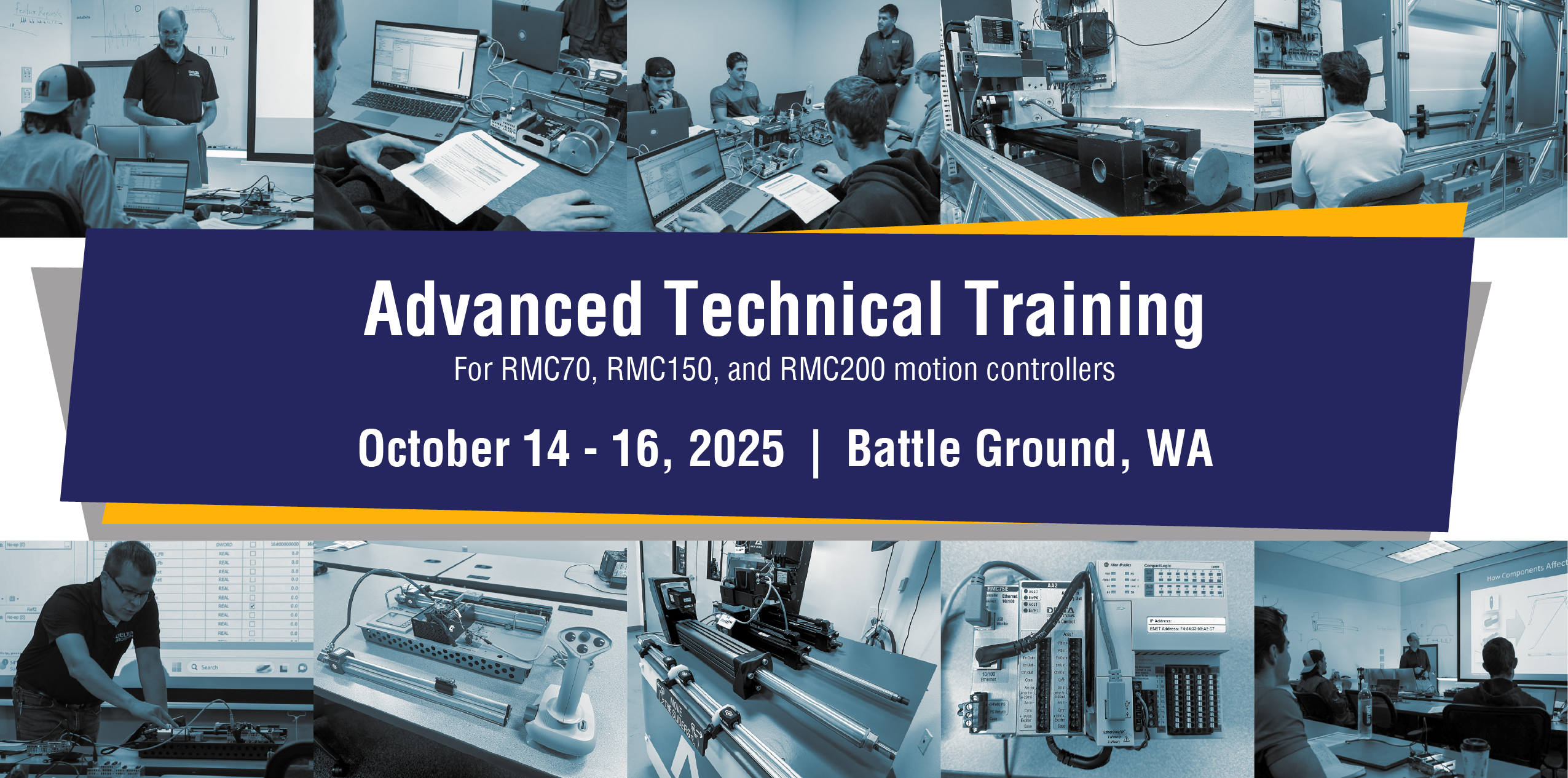
This three-day course (eight hours per day) provides an in-depth exploration into advanced motion control concepts, featuring hands-on breakout sessions with real, live hydraulic and electric systems.
Completion of this course will provide a deeper mastery of Delta Motion's RMC motion controllers and RMCTools software—unlocking advanced functions, fine-tuning precision control, and gaining hands-on experience that you can immediately apply to real-world applications.
Topics covered in this course include:
|
|
- Advanced position tuning
- Setting up a controller
- Pressure-force control & tuning
- Advanced programming techniques
- Overlapped & non-linear valves
- PLC communication
|
- Tuning for underdamped systems
- Gain scheduling
- Servo motor control & tuning
- Gearing & camming
- Curves
- And more
|
|
|
Prerequisites: Completion of RMCTools Technical Training
|
|

|
|
Want to stay up to date with the latest from Delta Motion?
Follow us on social media for industry insights, tech tips, product updates, event news, and more!
📢 Follow us here:
LinkedIn
Facebook
YouTube
Your support helps us grow, and we’d love to connect with you!
|
|
Delta Computer Systems, Inc. dba Delta Motion
1818 SE 17th Street
Battle Ground, WA 98604
+1 (360)254-8688
Delta Motion Ltd.
5 South Charlotte Street - Edinburgh, EH2 4AN, United Kingdom
(+44) 0131 447 7924
Email us at marketing@deltamotion.com.
|
|
|
|
|